Startup design in 2026: what you actually need at each stage so you don’t overinvest but also don’t fail
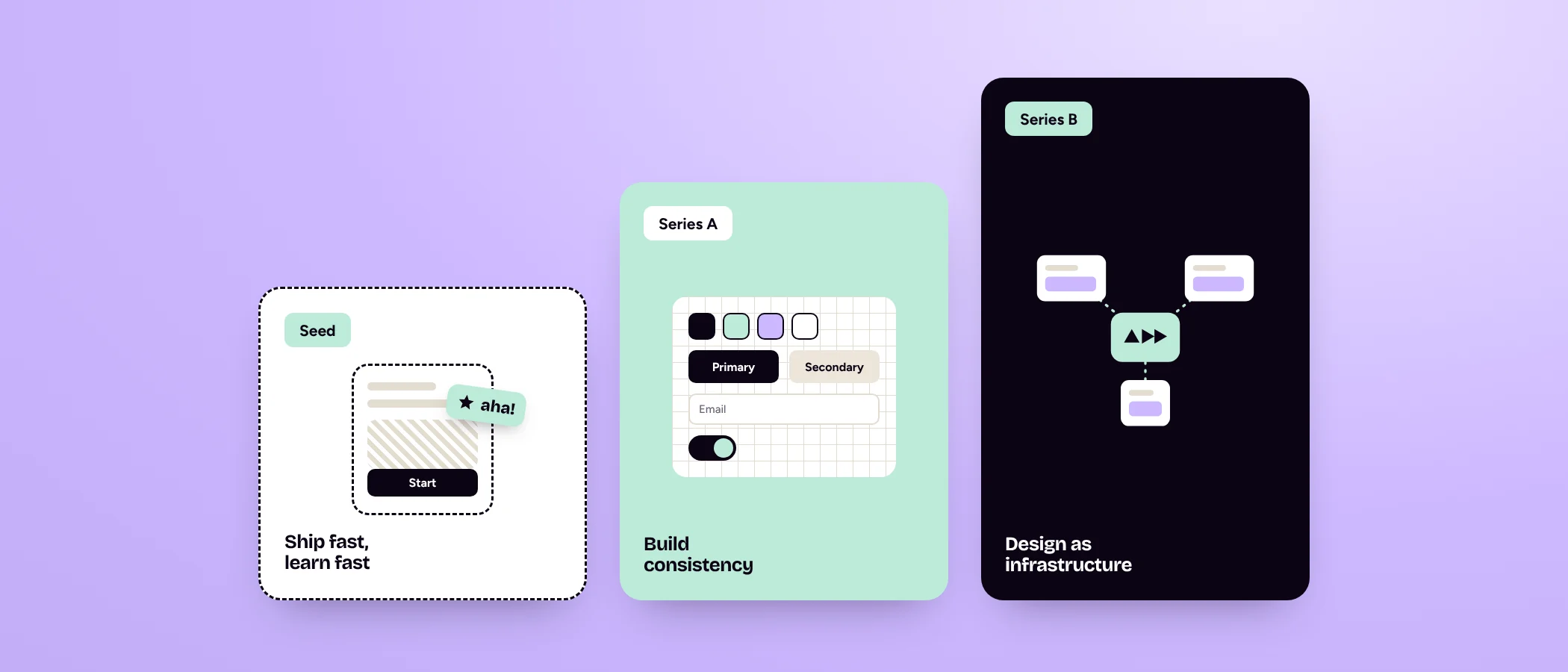
Most startups get design wrong.
Not because they don’t care about it. But because they invest in the wrong type of design at the wrong time.
We’ve seen seed-stage founders spend six figures on a brand identity before they’ve found product-market fit. We’ve also seen Series A companies still shipping screens from Figma files held together with duct tape and good intentions.
And recently, we’ve been seeing the biggest mistake of them all – ignoring how much AI has changed the equation. Seed founders can go from idea to testable prototype in hours; Series A teams need fewer designers; and Series B systems stay leaner.
The times, they’re a-changin’.
Here’s what design actually needs to look like at each stage of your startup.
Seed stage – ship fast, learn fast, survive
You’ve got plates spinning. So many plates.
Money is tight.
At this point, you might not even think of design as a separate thing, because you’re just trying to get your idea out there and into the hands of your users.
And you’re sitting there, comparing your product to that of a competitor, all polished and smug.
You might be embarrassed, looking for permission to ship ugly.
Well, this is that permission you’ve been seeking!
Given that only about 15% of startups make it to the next stage, you want to give yourself the best chance at success and that means a scrappy MVP.
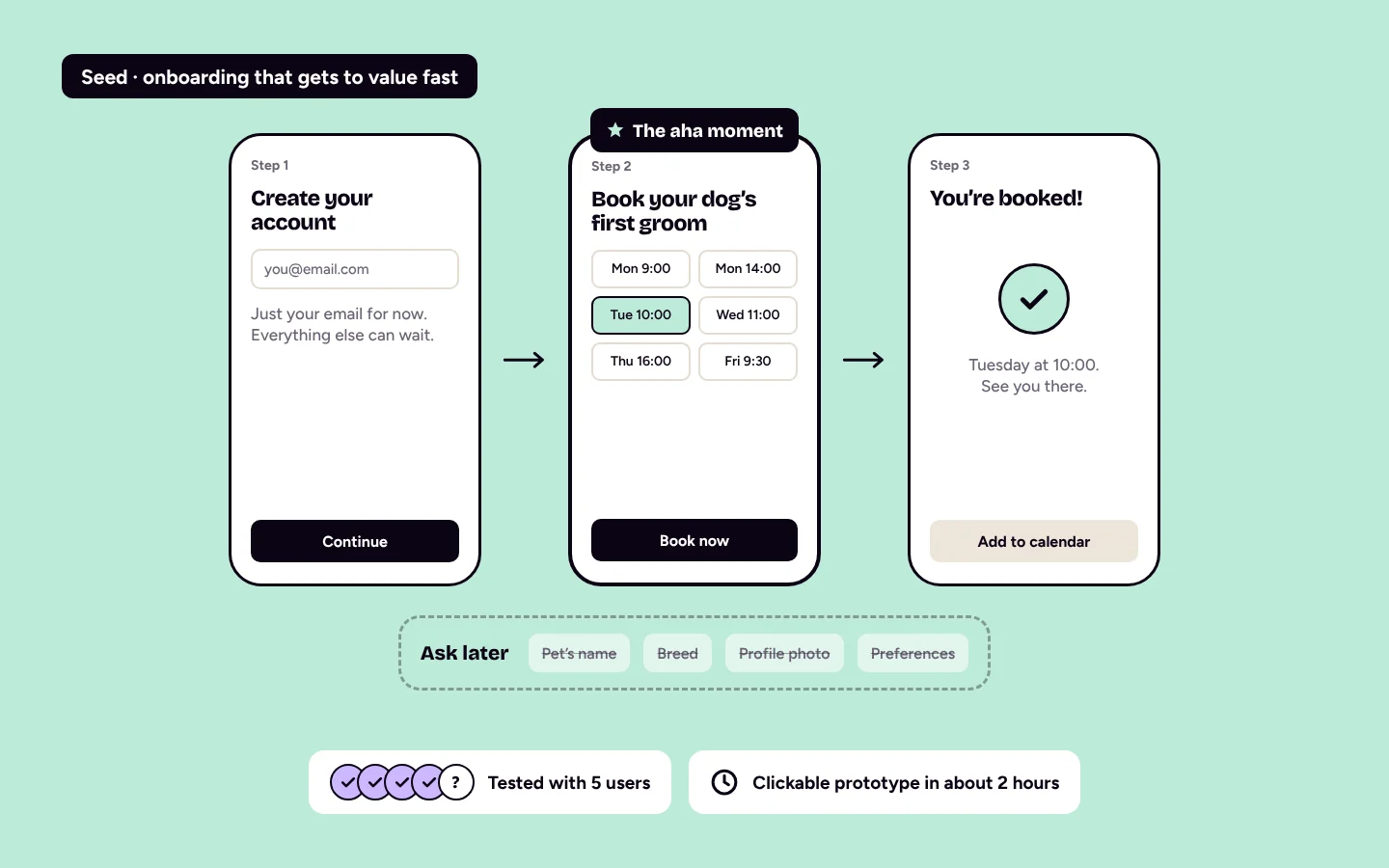
Your main goal: get your users to that “aha moment” (aka value) as fast as possible.
That’s it. That’s all your design needs at this stage, and it mostly involves getting someone signed-up and onboarded.
Getting onboarding UX to “good enough for now”
Onboarding shouldn’t be this big, chunky, elaborate thing. On the contrary: it’s lean and it’s streamlined.
It doesn’t need question upon question for personalization. Leave that for later.
Think about asking for the minimum amount of info you can get away with to demonstrate your product’s value.
- Write down very clearly what the main value of your product is – the one thing.
- Map out the happy flow of your user journey and make it all about the one thing. Show it off as early in the flow as possible.
- If it’s a pet grooming app, invite people to book their first appointment right away. Do you really need their pet’s name? Leave that for their next session.
- Got a health and safety app for workplace training? Let them get started on their first mandatory course without getting all of their personal details.
- Give that flow to AI to create a clickable prototype in just a few minutes. Iterate till you get something good enough (up to 2 hours usually).
- Test with 5 potential users. This is what matters most in this stage. If the people get through it and “get it,” you’re on the right track. If not, go back to step #2; maybe you’re showing value too late, or asking for too much too early, or the sequence is just off. A pair of strategic senior designer eyes can also help you get unstuck here.
- Hire a freelance designer ($3-4K) to create a functional, clean interface that can be properly developed. The designer has to be someone who’s simply good at executing by using AI tools and workflows. Or work with a studio like us that’s done this many times.
- And you’re rolling.
The biggest design fails of seed stage startups
Time and time again, startups come to us having shot themselves in the foot. Don’t be them.
- Don’t polish what might (will) be thrown away next week. Every dollar spent on making the UI look pretty now is burning your runway. Sure, this isn’t the “right way” to do design, but it almost never makes sense to invest heavily into design that might not survive.
- Don’t hire in-house designers. They’d find plenty of things to do but you should only really be interested in getting to PMF at this point. Don’t burn money that you need to get to PMF. Stick with studios or contractors. You can also hire a senior designer with expertise in your field to do a mini audit to make sure you’re on the right track.
- Don’t build a design system. You might come up with a rudimentary one with the help of AI and your freelancer.
- Don’t avoid taking on design debt. It’s there by design, pun intended. No startup ever failed because it didn’t have a design system.
Series A – pay down the debt, build consistency, hire smart
You made it. You’re in the ~15%.
You’ve got product-market fit (or something close enough that investors believed you). You’ve got revenue. You’ve got a team that’s growing.
You’ve also got a product that, let’s be honest, doesn’t hold up anymore. And now you have to prove to your investors that it scales.
As the number of users grows, the requests start coming in and you’re tacking them on. More use cases arise, and each case is “edgier” than the previous one. You’re also working down the backlog.
There’s lots of activity but none of it is orchestrated from a design perspective.
It’s time to clean the house.
Spending on product design in this stage will depend on how long it takes to get acquisition and retention metrics looking healthy.
Your main goals:
- Hire your first designer or agency.
- Fix or build your core user journeys.
- Build a basic design system.
1. Hire your first designer or agency (and do it right)
At this stage of your startup is where a product (UX) design resource starts making sense.
We know it hurts the co-founder(s) to hand off their baby to someone else, but it must be done for the product to become better.
- Get an AI-forward senior. You need someone, either fractional or full-time, who can own strategy, research, user experience, and the UI, wrapped up all in one person. You won’t have time to hand-hold, still wearing a lot of hats yourself. This person will be working in an AI-first way to speed things up and require fewer designers on your team. It allows for less handoff and interactive prototyping.
- Look for someone who has worked in the startup world before. There will be plenty of ambiguity and speed, and if you get someone who’s used to a slower-paced corporate job, they might buckle under pressure.
- Supplement with a UX studio for bigger lifts, such as rethinking a core journey, fixing onboarding, building out a new product area. While your in-house designer handles the day-to-day, a studio like ours comes in when you need someone to untangle a broken flow or rethink an experience that’s costing you customers.
2. Fix and build your core user journeys
You’ve probably bolted on features to keep your customers happy. And to cater to the ever-rising number of use cases.
But now your UX has dead ends, weird flows, and things that made sense six months ago but don’t anymore.
Here’s what you’ll do:
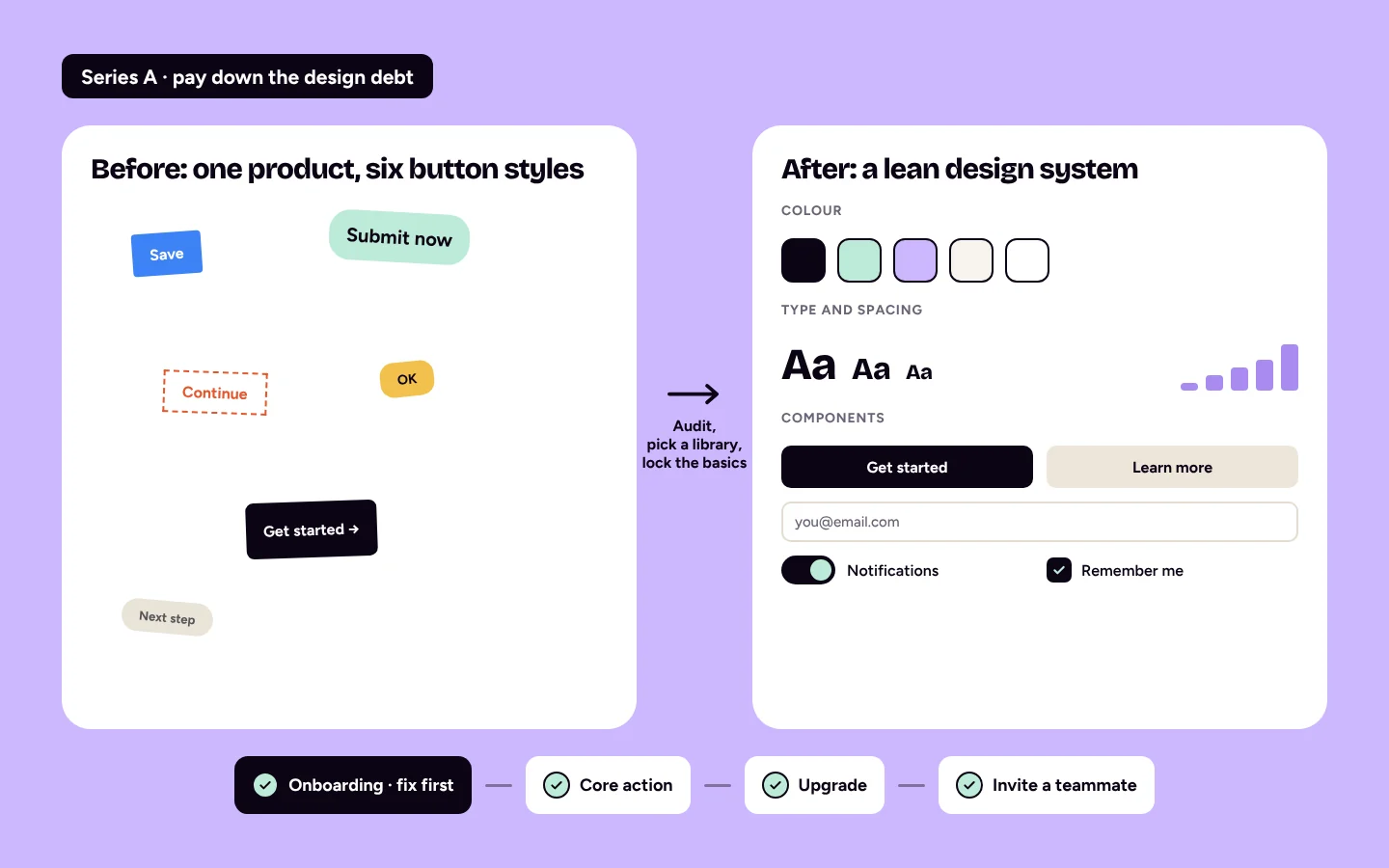
- Identify your top 3-5 user journeys. If you’re not sure which journeys matter most, follow the money. These are almost always on the list: onboarding and first value, core action loop, upgrade or purchase, invite or collaborate, “I need help,” etc.
- Walk through each one yourself, on multiple devices if relevant, from start to finish. Time it and document it, noting every moment of friction. Be honest – each hesitation counts. You can document with AI, but it’s really valuable to eat your own dogfood.
- BONUS: run usability research with actual users or rope in people who’ve never touched your product before, but have a clear use case for it. AI tools help speed this up.
- Ruthlessly prioritize the fixes. Where are users dropping off? What’s generating support tickets? Start where the financial “damage” is the worst. The math is simple: if fixing one flow improves your activation rate by even 10%, that compounds across every user you acquire from here on out. At this stage of your startup, that can be the difference between hitting your growth targets and missing them.
- Publish the fixes. AI tools and workflows make sure this can happen quickly and iteratively.
It’s also at this stage of a startup where personalization starts making sense, which can give a nice boost to the overall user experience.
Don’t have the time? This is exactly what we do. We come in, walk your flows, find the friction, and help you ship the fixes.
3. Build a basic design system
A tell-tale sign that you need a design system is when engineers start debating UI.
So go and save everyone the time and headache, and build a design system. Not a fancy one. Not one that wins awards. A lean one.
- Audit what you’ve got. Grab screenshots of every key screen and let AI compare them. You’ll immediately start noticing mismatches which must be documented and corrected.
- Pick a component library (like Shadcn, Radix, or MUI) and commit to it. Customizing an existing library is 10x faster than building from scratch and your engineers will thank you.
- Lock down the basics: colors, typography, spacing, button styles, form inputs. That’s it. Don’t go overboard. You just need enough consistency that your product feels like one product.
- Document it somewhere your team can actually find. A Notion page, a Figma file, whatever. If it lives in someone’s head, it doesn’t exist. AI can help you write this all up, no need to put pen to paper.
The biggest design fails of Series A startups
Other people’s stubbed toes are your gain.
- Don’t mistake design for making things pretty. If you come from a non-design background, it’s likely you still think design is about making things pretty. Design owns cohesion in your user journeys, breaking down silos. Get your designers into strategy conversations and roadmap planning – that’s how you’ll get real value.
- Don’t redesign everything at once. You’ll burn months, frustrate your engineers, and ship nothing. Pick the highest-impact journey first, nail it, then move to the next. A good UX studio will help you figure out which broken experience is actually losing you money.
- Don’t hire too many designers too fast. One great senior designer can do more than three juniors. Scale the team when there’s actually enough work to justify it, not because you raised money and it feels like the thing to do.
- Don’t skip the design system. At Series A, design debt is what kills you by making your product look amateur as you’re looking for scale. Yes, it feels like overhead. Yes, it takes time. But every week you wait, your engineers are building more inconsistency into the product and your users will pay for it.
Series B – design becomes infrastructure
You’re scaling.
More customers. More features. More teams. More of everything, including going deep into personalization.
That one fractional designer you hired at Series A? They’re stretched thin, context-switching between six projects, and starting to wonder if they should just quit.
Not to mention that the user experience affects enterprise deals, partnerships, PR, and many other moving parts of your company. The stakes just got higher.
Design now needs systems, processes, and people.
Your main goals:
- Build a design team.
- Invest in UX research and writing.
- Level up your design system.
1. Build a design team
Design isn’t a service team; it’s a strategic one. So what you need is a team that’s put together deliberately, able to spar with leadership, and able to drive the user-first agenda forward.
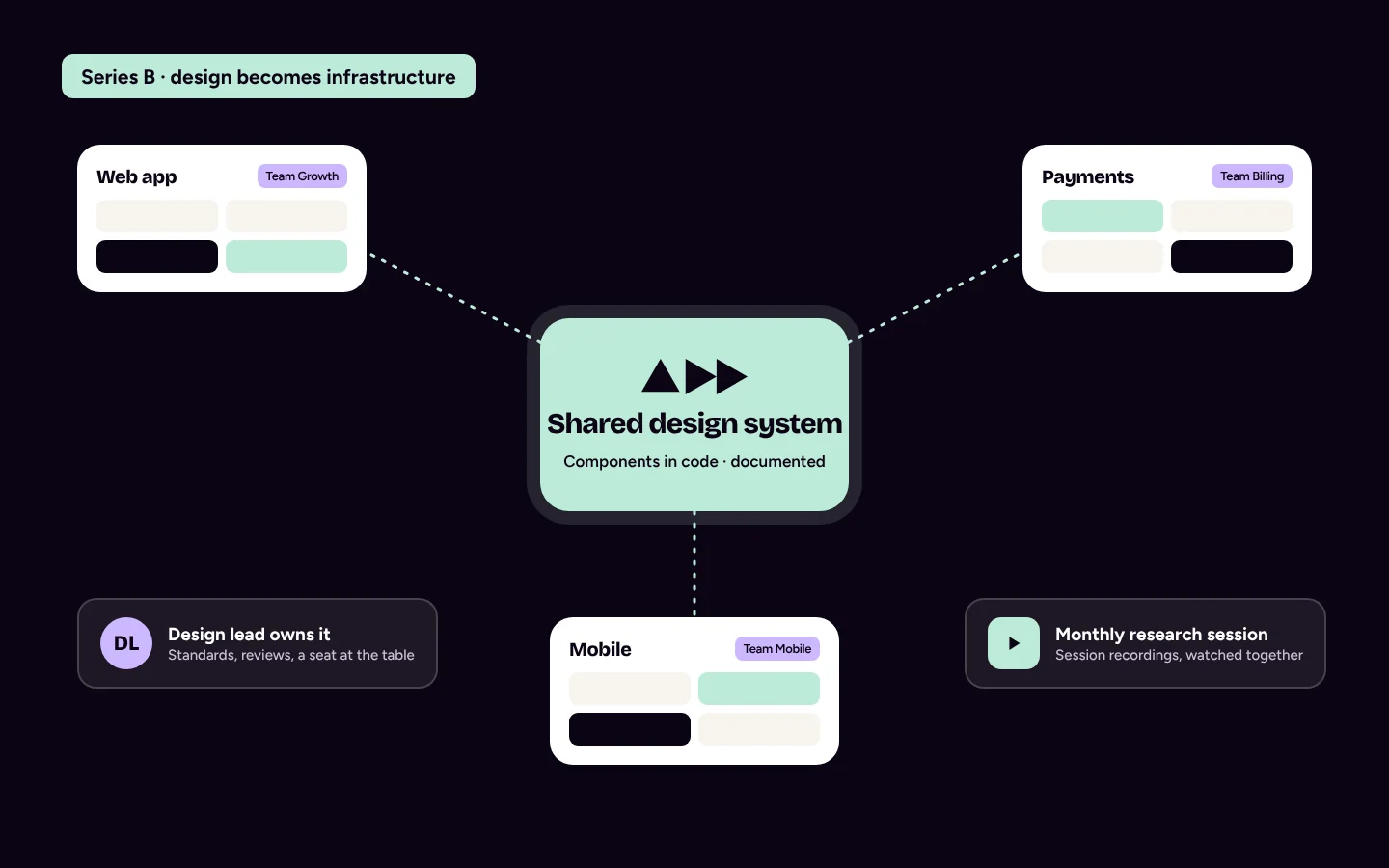
- Hire a design lead to run the team. It should be someone who can manage your team, set standards, and fight in the corner of “user” at the leadership table. Could it be the person you hired in Series A? It’s possible but if they don’t have the stakeholder management skills, hire above them and handle that conversation with grace.
- Figure out who you need. Alongside your lead, pad out the rest of the team. Don’t anchor yourself to some “ideal headcount.” Hire the best product (UX) designers you can afford. With AI tooling, processes look way different now and fewer people are needed, as they can orchestrate automations instead of being hands-on with every feature. Not sure what your team should look like? We can help.
2. Invest in UX research
You can’t afford to guess anymore. Each decision is too expensive to get wrong.
Sure, UX researchers are usually the very first people to go in tech layoffs but hear us out.
Researchers and writers have the unique skillset of getting to the very heart of product problems and solving them, or preventing them in the first place.
- Set up regular user research. Watching real people use your product will always surface things dashboards won’t. There are many AI-forward tools that can do session recordings too.
- Make research accessible to the whole team. Order pizza and get the whole team to watch session recordings together every month and before OKR planning. Product decisions should be based on actual user behavior, not opinions in a meeting room.
- Train team members to run research. If a dedicated researcher isn’t in the budget yet, train your PMs and designers to do it. It’s not ideal long-term, but it’s infinitely better than no research at all.
3. Level up your design system
That basic system you put together at Series A? Time to make it load-bearing, but not to the point of it becoming some bureaucratic apparatus.
Bringing in a studio to architect the foundation and hand it off to your team is usually faster and cheaper than figuring it out from scratch.
AI means fewer people maintaining your system, faster documentation, and automated consistency checks. That’s exactly how we work.
- Assign ownership. Someone (or a small team) needs to be responsible for maintaining and evolving the system.
- Build it in code. Your engineers should be pulling from a shared component library.
- Add documentation. The goal is that a new engineer or designer can build a screen that looks and feels right without asking anyone.
The biggest design fails of Series B startups
These are the most expensive mistakes you can make, not just in terms of design, but in terms of your product in general.
- Don’t let teams build in silos. When you’ve got multiple product teams, each one will start making their own design decisions. Before you know it, your product feels like three different products stitched together. The design system and design leadership exist to prevent this. You can also hire external help to run a cross-journey audit, mapping how users move between features, catching the inconsistencies your internal teams are too close to see, and flagging where the experience breaks.
- Don’t ignore your design system’s maintenance. Building it was step one. If nobody’s updating it, enforcing it, or iterating on it, teams will route around it and you’re back to square one – amplifying chaos. Did you know that fixing a UX problem at scale can cost up to 25x more than catching it during the initial design phase?
- Don’t undervalue design leadership. At this stage, you need someone who can translate design decisions into business outcomes and communicate that to the C-suite. If design doesn’t have a seat at the table, it’ll always be an afterthought, undermining user trust.
- Don’t confuse more designers with better design. Throwing headcount at the problem without clear processes, standards, and leadership just creates more chaos. Get the systems right first, then scale the team into those systems.
Whether you’re shipping your first MVP or untangling a product that’s outgrown its UX, we’ve been in these rooms before.